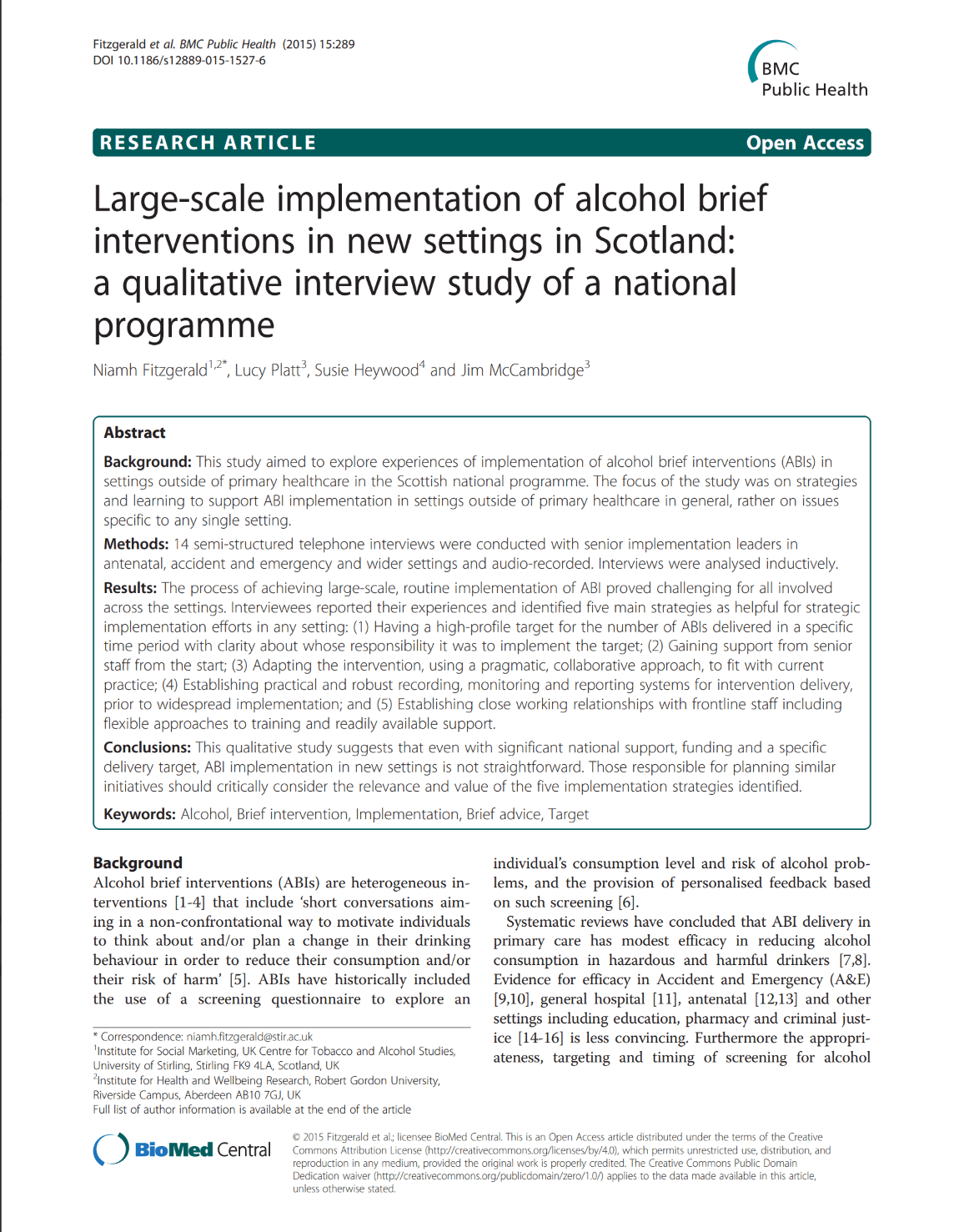
Large-scale implementation of alcohol brief interventions in new settings in Scotland: A qualitative interview study of a national programme
Abstract Background: This study aimed to explore experiences of implementation of alcohol brief interventions (ABIs) insettings outside of primary healthcare in the Scottish national programme. The focus of the study was on strategiesand learning to support ABI implementation in settings outside of primary healthcare in general, rather on issuesspecific to any single setting.Methods: 14 semi-structured telephone interviews were conducted with senior implementation leaders inantenatal, accident and emergency and wider settings and audio-recorded. Interviews were analysed inductively.Results: The process of achieving large-scale, routine implementation of ABI proved challenging for all involvedacross the settings. Interviewees reported their experiences and identified five main strategies as helpful for strategicimplementation efforts in any setting: (1) Having a high-profile target for the number of ABIs delivered in a specifictime period with clarity about whose responsibility it was to implement the target; (2) Gaining support from seniorstaff from the start; (3) Adapting the intervention, using a pragmatic, collaborative approach, to fit with currentpractice; (4) Establishing practical and robust recording, monitoring and reporting systems for intervention delivery,prior to widespread implementation; and (5) Establishing close working relationships with frontline staff includingflexible approaches to training and readily available support.Conclusions: This qualitative study suggests that even with significant national support, funding and a specificdelivery target, ABI implementation in new settings is not straightforward. Those responsible for planning similar initiatives should critically consider the relevance and value of the five implementation strategies identified.Keywords: Alcohol, Brief intervention, Implementation, Brief advice, Target