
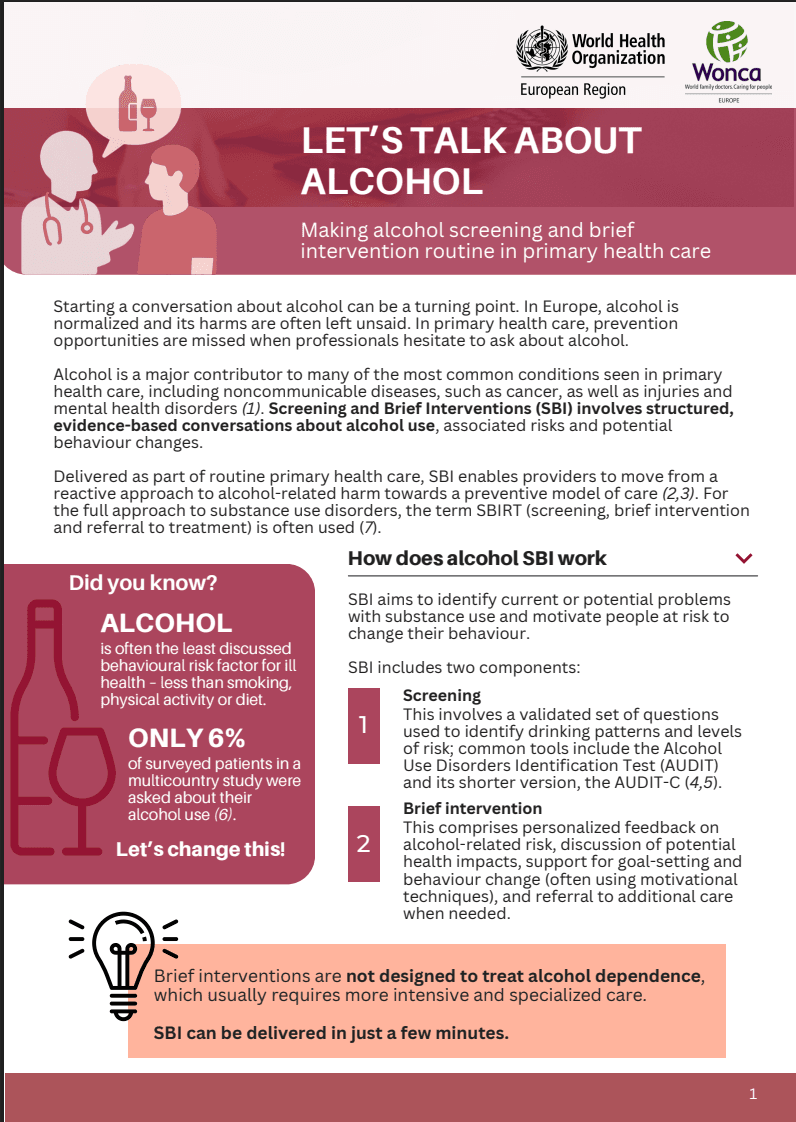
Let's talk about alcohol: making alcohol screening and brief intervention routine in primary health care
Short 2 pager encouraging alcohol screening and brief intervention to become a standard part of routine primary health care.
Loading...
We use cookies to analyse site usage and improve your experience. For more information on how we use cookies, please see our Terms of Use and Privacy Policy .
Health practitioners in primary and specialist care are key entry points for alcohol screening and brief interventions.
Routine contacts across family medicine, emergency departments, mental health care and other specialist services (including hepatology, gastroenterology, oncology, trauma, antenatal care and reproductive and sexual health) create opportunities to identify alcohol use early and integrate brief support into clinical practice - including in the context of injuries, comorbidities, medication safety, treatment planning and also what matters the most for the patient.
Interventions on alcohol are not limited to alcohol dependence: they can help address a wider continuum of alcohol-related risk and are most effective when embedded in routine care pathways and supported by training and clear referral options.

Find resources for health practitioners
Short 2 pager encouraging alcohol screening and brief intervention to become a standard part of routine primary health care.
On a European scale, drinking alcohol results in suffering and costs of enormous proportions, which have an impact on the health and welfare of men and women, children and adults, rich and poor, those who do the drinking and those who bear the consequences of the drinker’s behaviour. Alcohol-related problems have many causes, arise in various situations and affect different types of people. The response to these problems therefore needs to be comprehensive, involving public policy, community programmes and action at the primary health care level. The WHO European Alcohol Action Plan stresses that health care systems, traditionally involved in managing alcohol problems, must play a greater role in the detection and prevention of alcohol-related harm. Primary health care is seen as an important setting for identifying those at risk from heavy drinking and helping them to reduce their consumption. It is also the major supporter of families and self-help groups, and acts as an advocate of public health for local communities. This book goes some way to answering the question of how the harm done by alcohol use can be prevented and managed in primary health care. It discusses strategies and approaches that can be adopted by primary health care providers in their everyday work with individuals and families, and outlines the possibilities for them to participate in community action and to advocate for healthy public policy on alcohol.
Brief interventions have proven to be effective and have become increasingly valuable in the management of individuals with hazardous and harmful drinking, thereby filling the gap between primary prevention efforts and more intensive treatment for persons with serious alcohol use disorders. Brief interventions also provide a valuable framework to facilitate referral of severe cases of alcohol dependence to specialized treatment. This manual is written to help primary care workers - physicians, nurses, community health workers, and others – to deal with persons whose alcohol consumption has become hazardous or harmful to their health. Its aim is to link scientific research to clinical practice by describing how to conduct brief interventions for patients with alcohol use disorders and those at risk of developing them. The manual may also be useful for social service providers, people in the criminal justice system, mental health workers, and anyone else who may be called on to intervene with a person who has alcohol-related problems. This manual is designed to be used in conjunction with a companion document that describes how to screen for alcohol-related problems in primary health care, entitled “The Alcohol Use Disorders Identification Test: Guidelines for Use in Primary Care”. Together these manuals describe a comprehensive approach to alcohol screening and brief intervention in primary health care.
Worldwide there are approximately 5.2 million deaths from injuries every year and non-fatal injuries account for about one-tenth of the global burden of disease. Injuries may be divided into two categories: unintentional injuries, including road traffic injuries, drowning, burns, poisoning and falls; and intentional injuries, which result from deliberate acts of violence against oneself or others.

Reflect on common attitudes towards alcohol
Primary health care is a key setting for implementing screening and brief interventions for alcohol, as it provides regular contact with patients and manages many conditions linked to alcohol use. Despite strong evidence of effectiveness, SBI is still not routinely implemented in many countries. Monitoring its implementation helps WHO and Member States track progress in integrating this intervention into routine primary care and identify gaps where scale-up is needed. This comparative overview shows whether SBI is routinely implemented in primary health care across WHO European Region countries, based on the WHO Global Survey on Progress with SDG Health Target 3.5 (2023).
| Andorra | No |
| Armenia | No |
| Austria | Yes |
| Azerbaijan | Yes |
| Belarus | Yes |
| Belgium | Yes |
| Bulgaria | Yes |
| Croatia | No |
| Cyprus | Yes |
| Czechia | Yes |
Page 1 of 5